Some songs do not merely live in the ear. They settle somewhere deeper — in the chest, in the fingertips, in the way you reach for colour when the world goes quiet. For me, the songs of Rabindranath Thakur have always been that kind of presence. Not background. Not memory. Breath.
Growing up, the melodies of Kobiguru were simply the air of the house — hummed while cooking, whispered before sleep, sung at the first light of a festival morning. They carried within them a whole universe: Krishna and Radha beneath the kadamba tree, the river, the rain, the ache of longing, and the grace of devotion. I did not study them so much as absorb them, the way cloth absorbs colour.
That imagination slowly found form — shaping itself around the timeless beauty of this eternal song.
The Encounter That Sparked This Piece
When I first encountered Pattachitra — truly encountered it, not as a footnote in a textbook but as a living thing held in the hands of a master chitrakar — I understood immediately that this was a language capable of holding what Tagore's songs already knew. The bold, contained lines. The orange skies made not of paint but of ochre and stone. The figures who do not so much stand in the frame as inhabit it, like actors who have never needed a stage.
Pattachitra was born in the temple town of Puri, in the shadow of the Jagannath tradition, and for a thousand years its primary subject has been the divine — Krishna, Radha, the Dashavatara, the great leelas. When I sat down to begin this piece, the marriage felt inevitable. Tagore had written of Krishna's flute as something that tears open the ordinary world. Pattachitra had been drawing that exact tear for a millennium.
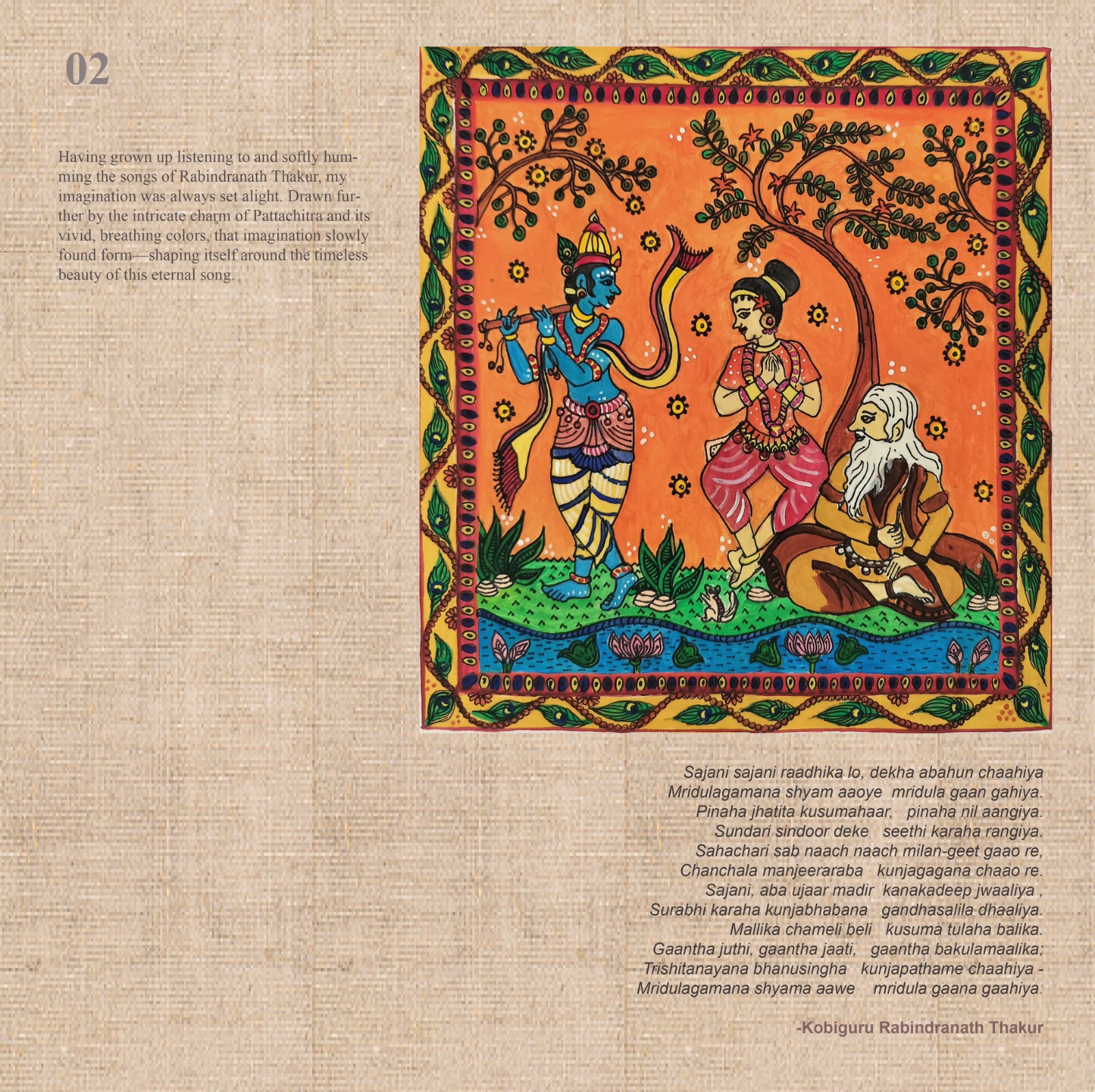
Pattachitra on cotton canvas · Earth-derived pigments · 45+ hours · Arunima Chakravarty Khadikkar
Reading the Painting
Look at the figure of Krishna — blue as the deep sky, crowned and jewelled, the flute at his lips as though the music has not yet ended and never will. To his right stands Radha, hands joined in devotion, her expression that particular mixture of ache and surrender that Tagore's Rabindra Sangeet understands better than almost any other art form.
And then, seated at the base of the tree, almost at their feet — a white-haired sage, bent forward in listening. I see in him every person who has ever closed their eyes at the opening notes of a Tagore composition and felt the ordinary world recede. He is the listener. He is all of us.
The border of the painting is alive with peacock feathers, flowering vines, and the characteristic bead-patterns of Pattachitra — each element painted stroke by stroke, no shortcut, no shorthand. The orange ground — the colour of a festival sky, of a lamp's first light — comes from mineral pigments prepared in the tradition of the craft. Nothing is simulated. Everything is earned.
Slowness as Devotion
This piece took more than 45 hours. That is not a number meant to impress — it is simply the honest account of what the work required. The preparation of the canvas. The laying of the ground colour in layers, each dried before the next. The outlining, done freehand, with a brush made from the tradition's own methods. The filling. The detailing. The border, which is its own world of patience.
Tagore once wrote that the highest form of worship is concentration. Pattachitra is a form of worship in exactly that sense — it demands that you be nowhere else. There is no rushing a border bead. There is no skipping the second layer of ground. The craft insists on presence in a way that, perhaps, is itself a kind of devotion to the song it depicts.
Every Lahe Lahe tote carries a Digital Artisan Bridge QR on its back. Scan it and you do not just learn the name and village of the artisan who painted it — you enter the work itself. You are not buying a bag. You are carrying a song.

Carry a Song Home
Browse the Heritage Canvas Collection — each tote individually hand-painted, each one unrepeatable. B2B wholesale and custom branding available.
Explore the Collection →