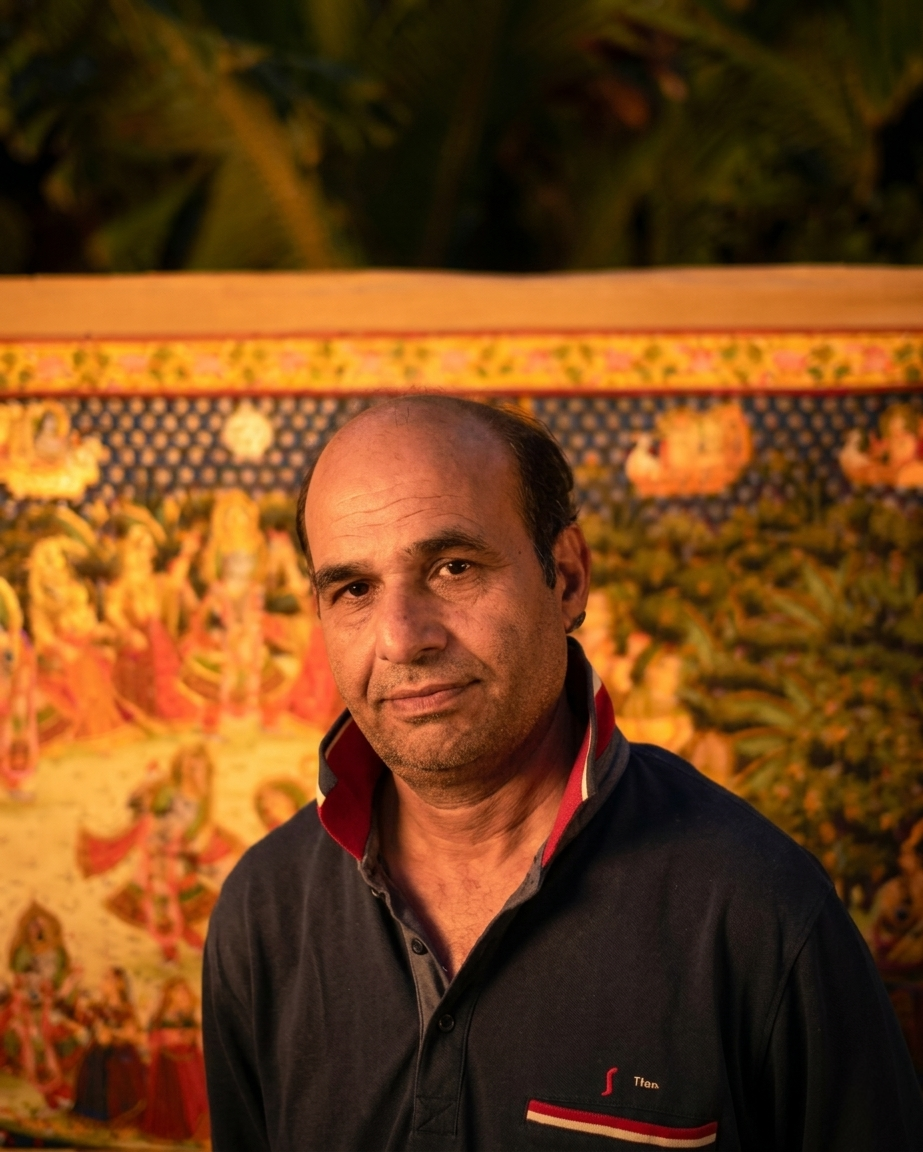
His Story
Three Generations
of Devotion in Paint
Dinesh Soni was born into Pichwai — not merely as an inheritance of craft, but as a way of seeing, being, and believing. A third-generation practitioner from Rajasthan, he learned at the feet of his grandfather and father in a lineage that has preserved this exquisite devotional art form through decades of change.
Pichwai painting originates in Nathdwara, a sacred town in Rajasthan and the seat of the Shrinathji temple. These large-format cloth paintings were originally created as backdrops for the idol of Shrinathji — Lord Krishna in his child form — changing with the seasons, festivals, and sacred calendar. Rich in narrative detail, vibrant in pigment, and suffused with devotion, Pichwai is as much a spiritual practice as it is an art form.
Over more than three decades, Dinesh has refined a practice of meticulous attention — to line, to colour, to composition, and to the stories being told. His works draw from the traditional themes of Shrinathji's divine life: the monsoon seasons, the lotus blooms, the cows and cowherd narratives of Vrindavan. Each piece is rendered in vibrant natural pigments, a technique that demands patience, knowledge, and reverence.
Beyond his own artistry, Dinesh is equally committed to the survival of Pichwai as a living tradition. He actively mentors younger artists, transmitting not only technique but the deeper ethos of this heritage. In 2019, the Government of India honoured him with the National Award, recognising both his skill and his lifetime of dedication to one of Rajasthan's most revered artistic legacies.
🏆
National Award · 2019
Conferred by the Government of India in recognition of Dinesh Soni's outstanding contribution to Pichwai painting and his dedication to preserving one of Rajasthan's most revered artistic traditions.
"Each piece reflects not only technical mastery but also a profound cultural and spiritual connection to the art form — a devotion alive in his family for three generations."
— Lahe Lahe Collectives